
Showing posts with label observation. Show all posts

Tuesday, June 3, 2014

Terra - My mum says I am...


The teachers talked to the parents about a word they would use to describe their child and these were the words that were shared. On the display there is a large photograph of each child below the word. These are the words that these parents use to describe their child and the aspirations they hold for them.
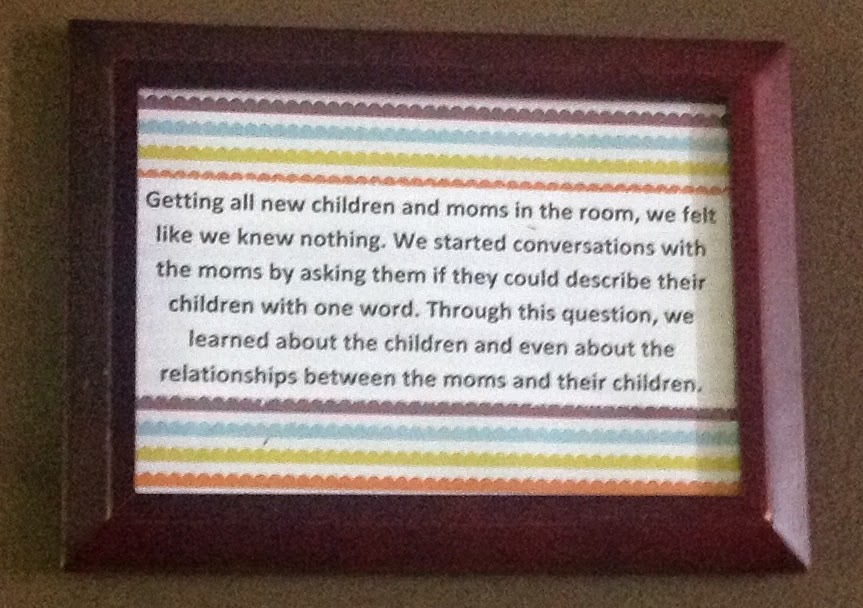
This is a great opportunity to include these aspirations and visualisations in the documentation to 'speak into that space'. 


It is powerful to affirm these aspirations and parent observations by paying attention to them with the child for planning, observations and assessment.

There are lots of opportunities to notice, recognise and respond to what we observe with children and use that information to innovate and be creative with our teaching

Bringing these aspirations from parents, their voice being heard to inform the teaching and included in the documentation


 I thought this was a great way to make visible the image of the child each parent holds for their child and include this in planning and assessment - making these things visible alongside all the other valued learning outcomes.


Saturday, May 31, 2014

Blogging to document children's learning

This centre uses blogger like you would not believe...I was so impressed with how they were using it I was asking Katrina for a few 'how to tips'. The children's learning is recorded through observation and published to their own individual blog. These are shared with families and the administration functions are shared with families so they can share the observations with the wider family and friends. You can see the tags/labels down the right hand side of the photo - the teachers tag each post entry so that if you wanted to track a particular series of learning areas or goals you could. I like that idea. All the informtion is there through the observations to write up a narrative assessment (learning story) over time. I really hope the centre takes this next step with assessment. 
When the new Alberta Curriculum comes out they could just add the principles and goals for learning to the labels/tags - makes life really easy.

Preparing for teaching and learning


Paint exploration

I am grateful to Debra and the Kinder Campus community for allowing me to photograph the displays in the centre that have children's images and learning encounters. This is one way this centre makes children's experiences and thinking visible. 
The teachers have taken the time to articulate the preparation that went in to this experience, including having a look at renowned painters. You will see that the teachers were noticing, recognising and responding to children's curiosities in the experience. The children's comments are captured alongside the encounter. 
 "That's abstract art"


Sunday, May 18, 2014

More photographs from University and Community Early Learning Centre

 The children have their 3D constructions on display for the family information evening
Below is one of the classrooms
 Setting the table
 Natural materials and neutral tones
 Props for dressing up and pretend play
 Gem stones on the wire - suspended from the ceiling
 Bringing the space down to meet the children
The presentation of the environment here is very important to invite children to be curious in spaces and play

Sunday, May 4, 2014

A Place to Play - Presenter: Brittany Atkinson - 2.45 - 4.15pm

It is understood that children learn through their play. Through play, children build relationships, make meaning, and shape their identities. Educators create spaces for children to play. What does it mean for children’s play, children’s sense of citizenship, and their social learning when they create their own places for their play? Brittany will share her experiences of supporting and expanding children’s play as they shape their own play spaces – their own invented worlds where they imagine, create, solve problems, and invite and participate with ideas and others.

This workshop was an inspiring story about how a teacher grappled with her own bias related to rural vs urban living. Three scenarios were shared how with her 'partners' (aka colleagues/ teachers/ educators) she carefully observed children through play. The workshop started with Brittany reading this book to us about childhood memories - this is significant for the theme of the workshop.


A critical feature of her reflections included being involved in children's play rather than distancing from the activity. Some careful decisions were made with children as the environment was adapted to support their play priorities. One scenario tracked how the winter olympics was MEANINGFULLY included in the programme to inspire children's learning and parents engagement. Great examples were shared of children making a curling rink at the centre....one parent commented on how proud his grandfather would be to know he was learning to curl a stone (made from freezing ice in a milk bottle so the children could hold it and send it across the ice). The photos showed children using brooms to sweep the way clear for the 'stone'. I thought this was very cool!!!


 Meet some of the amazing teachers at the early childhood centre and faculty staff I am meeting. From left to right - Brittany (workshop presenter), Mary Lynne (the person looking after me and faculty member), Jennifer (educator - also worked at Puddleducks for 3 months in NZ), Lee (faculty and curriculum developer), Rebecca (teaching for 3 weeks) and Erica (teaching for 1 week).

Thursday, April 24, 2014

Encounters with some children - observing for schema

I was allowed to roam free in the nursery this afternoon observing the teaching and learning space and interacting with children if possible. As I have mentioned, the children are very used to visitors and initiate interactions freely. I was watching some children racing up and down a long hallway with wooden trucks 'transporting treasures' from one end of the hall to the other (hallway may be up to 20m long - I am spatially challenged - and the 3 children were racing up it pushing trucks). Not once were the children asked to stop this activity and it went on for over half an hour noise and all....no drama...no crashing. Others knew to get out of the way and respected the activities.
 I met a child while we watched others play games on the computers. There were some animals on the bench so we started to play with them. The next series of photos show the way the play was repeated many times over - lining up the animals 'connecting them in a row'. The teachers talk a lot about schema in their every day language with children. It is a 'default' framework for thinking for the teachers. There is a strange chaos in the environment inside that the children joyfully navigate around.
 Sorting them this way and then that...
 each time different arrangement - applying different criteria to line them up
 These photos are the same - I wanted a more artistic photograph :O)
 The toy at the end is her own toy from home - you can see it is a bit different from the other animals.
Each of these photographs is a different arrangement of the same animals. The child would set them up and then flick them over. The children are free to explore their schema in ways that are meaningful to them. I am impressed by this as it may be thought of that this full on space is not carefully orchestrated...don't be fooled....it is!!!


Tuesday, April 8, 2014

The atelier

View of the Atelier at the International Centre - there are so many things to encounter


Here some decaying vegetation is presented in various phases of breaking down. The Atelier sets up the environment for the teachers to explore so they have recent hands on encounters with the materials rather than just presenting them to children

I love the idea here of exploring the repeating pattern of the cabbage - the drawing represents an observation of the pattern - 'the more you look at something in detail the more of the same you see'

Imagine children encountering this and exploring the drying and decaying fruit. The Atelierista is careful to present various stages of decay as well - this is so carefully thought out and presented to the children