Showing posts with label curriculum. Show all posts

Tuesday, June 3, 2014

Terra - My mum says I am...


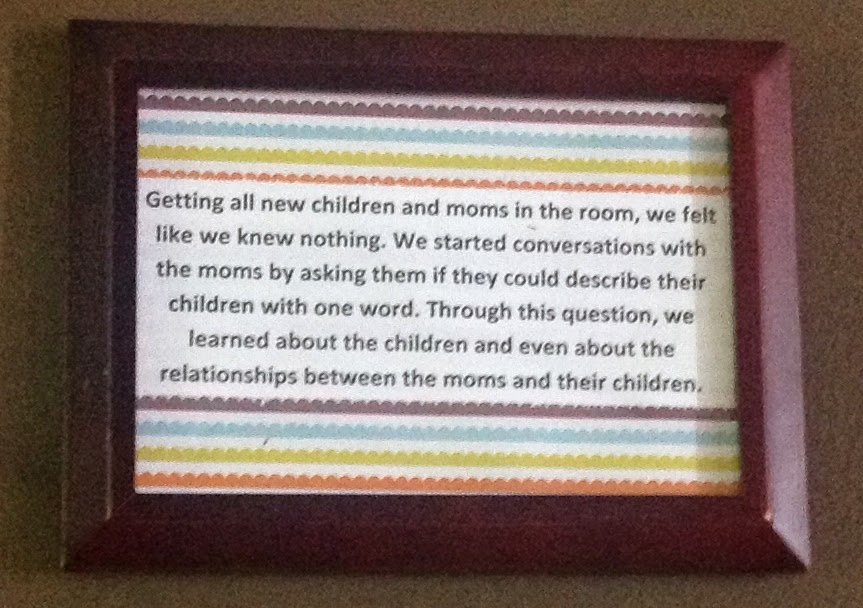
The teachers talked to the parents about a word they would use to describe their child and these were the words that were shared. On the display there is a large photograph of each child below the word. These are the words that these parents use to describe their child and the aspirations they hold for them.

This is a great opportunity to include these aspirations and visualisations in the documentation to 'speak into that space'. 


It is powerful to affirm these aspirations and parent observations by paying attention to them with the child for planning, observations and assessment.

There are lots of opportunities to notice, recognise and respond to what we observe with children and use that information to innovate and be creative with our teaching

Bringing these aspirations from parents, their voice being heard to inform the teaching and included in the documentation


 I thought this was a great way to make visible the image of the child each parent holds for their child and include this in planning and assessment - making these things visible alongside all the other valued learning outcomes.


Terra - Baby Cuddlers

In the rooms with the very youngest children, there is a very important role that volunteers play. The official title of this generous group of people is a 'Baby Cuddler'. Their role is to be with the babies  give them lots of attention. With the very young children, this ensures their needs are being met at all times, ensuring optimum experiences so early on.
Who would not want this job??
Thank you Margaret for allowing me to take this picture of you.

Sunday, May 11, 2014

Dr Ana Kirova - University of Alberta

I was lucky to be invited to attend a workshop on Friday 2 May - organised by the MacEwen Early Learning and Childcare Centre. My amazing friend and host Mary Lynne has some amazing connections and the early childhood centre is also what is called a 'lab' centre. This means that they host many groups of visitors during the year and faculty staff have close connections with the centre. They have also been one of the development centres for the new Alberta curriculum.The workshop was a 'low key' dialogue about culture, specifically focused on celebrations. The teachers have been reflecting on the impact of celebrations throughout the year on the programme and the expectations this has created from the community.

Activity time:

We went through an exercise where we thought of a celebration and had to identify our not negotiable through to those things we can do without. We used the diagram below to select a celebration and as an individual - at the top we identified something about that celebration that was critical for you, then next two very important, three in middle as important, next two as could do without if necessary and that last one represented the feature that was not important at all.


When we got talking in groups with our diagrams, it became clear that the things in the middle row were typically a 'shared space'. It was a really useful activity to go through as we got to see the things that are important to others that we may not have identified as being so critical. It was interesting to see how much we shared as a 'important' and could see how this would be a great way to develop curriculum experiences around cultural celebrations. Ana shared how the three boxes at the top are typically those things that describe how we celebrate at home and are not necessarily as relevant for our work at the early childhood setting. I really liked this way of thinking about it as it can be difficult to 'practice the celebration in a shared space'.
We talked about how over time cultural celebrations get distorted through retail hype and the opportunity to 'make a buck' and mostly this was what was represented in the box at the bottom.
Did you know that in many cultures, birthdays are not important - your name is the reference for celebration and this can be in recognition of a saint or flower? I love this idea.

Discussion points:

  • We discussed the importance of 'minimising' the significance of dominant cultural celebrations to make space for cultural celebrations of all children.
  • Commercialism strips away culture - making a choice not to participate in a commercialised construct of a celebration.
  • Political correctness is deadly to multiculturalism
  • having mature conversations about culture with children

Quotes of the session - 
"It is not up to teachers to teach a child their [the child's] culture"
"It does not matter so much what we say - it is what we do"

Friday, May 9, 2014

Professional Development - Kiwi Style with Team Grant MacEwan Child Care

The team at Grant MacEwan Child Care asked to have a professional development session about some of the things we started to talk about on Friday. We have had a dialogue about learning stories, narrative assessment and planning - were keen to keep the conversation going especially now I have spent some time in the centre.

Link here for Grant MacEwan Child Care team presentation


These are our notes and thinking from the discussion about the VORTEX. This thinking maps so well on to the processes in the centre and I was so excited to share our VORTEX concept from NZ with the teachers. The team were getting tired and they hung in there for the discussion. I have introduced the teachers to Google Drive and shared some photos of our beautiful centres back home.
Please send me 3 photos from your centre that I can share with this centre to show them the diversity of ECE in Aotearoa NZ.


Thursday, April 24, 2014

Curriculum in action - time in the Nursery


The centre follows the EYFS standards for learning from Birth to 5. Teachers assess progress against these priority areas. this is what I was referring to in my earlier post...this brings into question - if it is not observed at the nursery, does that mean the child does not have the skills and knowledge. This relies heavily on the capacity of the teacher to recognize this in play - what do you think??

These are the seven areas:
1.6 Educational programmes must involve activities and experiences for
children, as follows
•Communication and language development 
involves giving children opportunities to experience a rich language environment; to develop their confidence and skills in expressing themselves; and to speak and listen in a range of situations.
•Physical development
involves providing opportunities for young children to be active and interactive;
and to develop their co-ordination,control, and movement. Children must also be helped to understand the importance of physical activity, and to make healthy choices in relation to
food.
•Personal, social and emotional development
involves helping children to develop a positive sense of themselves, and others; to form positive relationships and develop respect for others; to develop social skills and learn how to manage their feelings; to understand appropriate behaviour in groups; and to have confidence in their own abilities.
•Literacy
development involves encouraging children to link sounds and letters and to begin to read and write. Children must be given access to a wide range of reading materials (books, poems, and other written materials) to ignite their interest.
•Mathematics
involves providing children with opportunities to develop and improve their skills in counting, understanding and using numbers, calculating simple addition and subtraction problems; and to describe shapes, spaces, and measures.
•Understanding the world
involves guiding children to make sense of their physical world and their community through opportunities to explore, observe and find out about people, places, technology and the environment.
•Expressive arts and design
involves enabling children to explore and play with a wide range of media and materials, as well as providing opportunities and encouragement for sharing their thoughts, ideas and feelings through a variety of activities in art, music, movement, dance, role - play, and design and technology